Sustainable conversion of CO₂ into cyclic organic carbonates
MSc thesis · University of Warsaw · Graduated with Distinction
2024 – 2026
Full title: Sustainable conversion of CO₂ into cyclic organic carbonates using selected tandem catalysts based on carbon nanotubes
Topics: carbon capture and utilisation · green chemistry · heterogeneous catalysis · nanomaterials
My contributions: catalyst design and synthesis, material characterisation, catalytic testing, data analysis
Skills used: nanomaterial synthesis, UV-Vis spectrophotometry, SEM-EDS, gas chromatography (GC), thin-layer chromatography (TLC), high-pressure reactor work, data visualisation
Thesis at a glance
| Degree | MSc in Sustainable Development, with Distinction |
| Institution | University Centre for Environmental Studies and Sustainable Development, University of Warsaw |
| Supervisor | Dr. hab. Elżbieta Megiel, Associate Professor, Faculty of Chemistry, University of Warsaw |
| Completed | July 2026 |
| Best result | 99.8% conversion and 71.3% yield of styrene carbonate |
Why it matters
CO₂ is the main greenhouse gas, and switching to renewable energy alone is not enough to bring emissions down. Carbon capture and utilisation (CCU) offers a complementary route: treating CO₂ as a raw material instead of waste.
One of the most promising CCU products are cyclic organic carbonates (COCs), used in batteries, green solvents and polymers. They are usually made from CO₂ and epoxides, which are toxic. A cleaner alternative is oxidative carboxylation: starting from cheaper, safer olefins and converting them to carbonates in a single “one-pot” process. This requires a catalyst that can do two jobs at once.
What I did
I designed and synthesised a new tandem catalyst combining two types of active sites on one support:
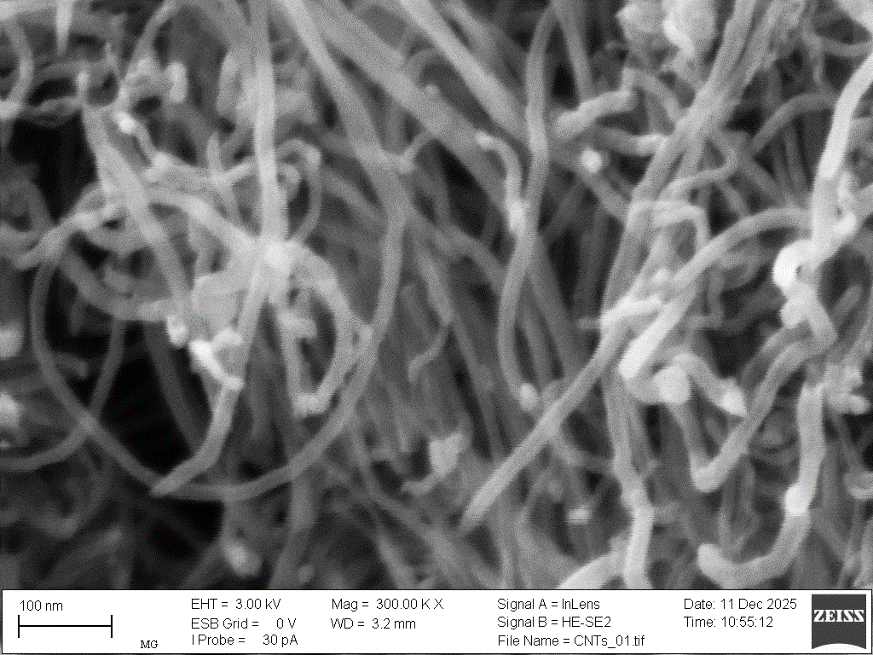
- Multiwalled carbon nanotubes (MWCNTs), a support material that can be produced from organic waste, functionalised with tetrazolium–bromide groups to drive CO₂ cycloaddition
- Silver nanoparticles stabilised with polyethyleneimine (AgNPs•PEI) to drive the epoxidation step
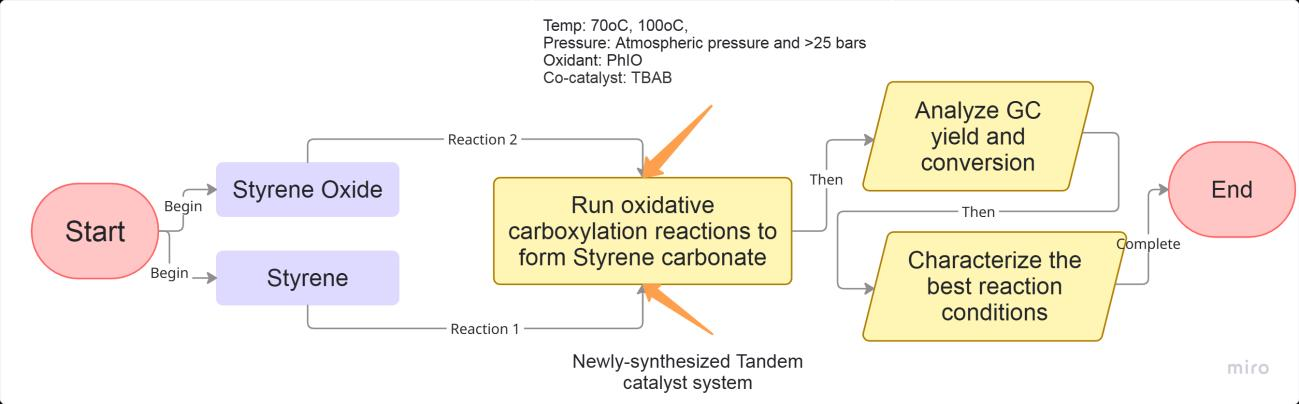
I then tested the catalyst on two model reactions, using styrene oxide and styrene, under mild conditions (70–100 °C, 1–26 bar CO₂), with and without a co-catalyst (TBAB).
Key findings
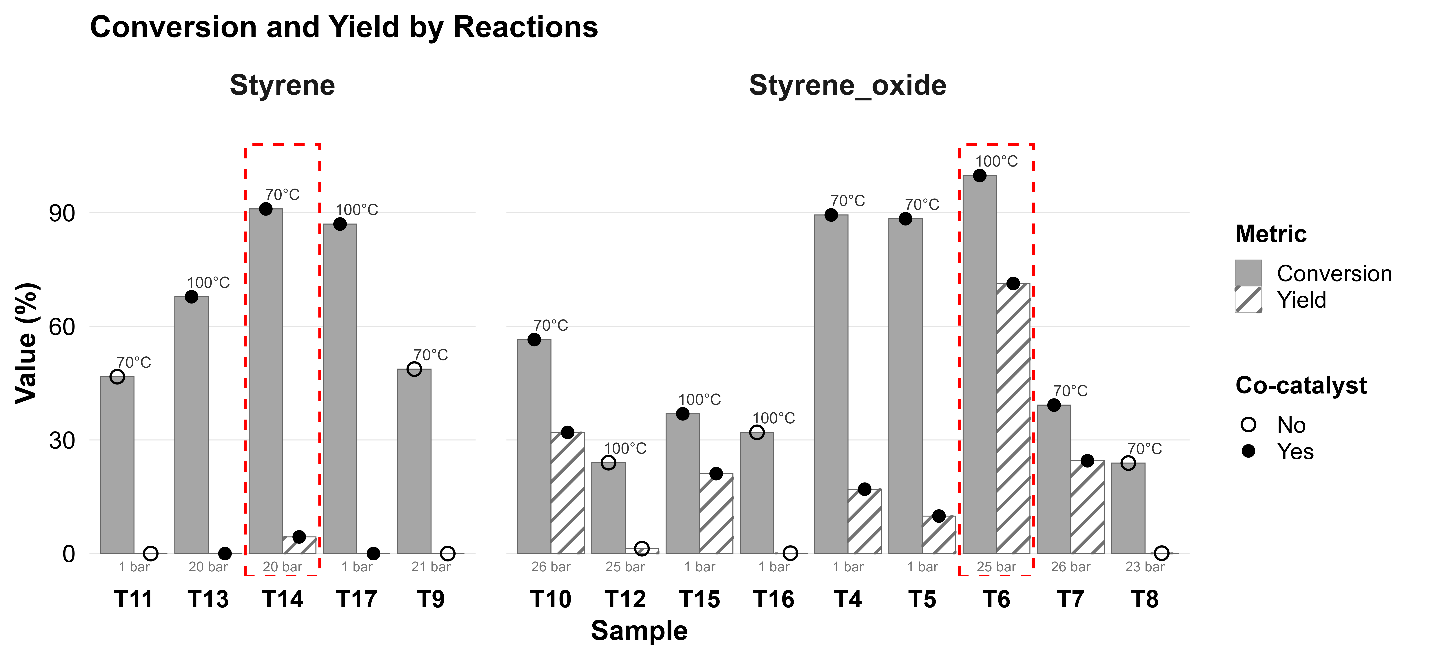
- CO₂ + styrene oxide: up to 99.8% conversion and 71.3% yield of styrene carbonate (71.5% selectivity) at 100 °C and 25 bar, competitive with other heterogeneous catalysts reported to date
- One-pot route from styrene: high conversion (up to 91%) but low carbonate yield (below 5%), showing that selectivity, not conversion, is the bottleneck
- The co-catalyst is essential: adding TBAB raised the average yield from 0.5% to 29.3%; without it, yields stayed near zero regardless of temperature or pressure
- Catalyst design matters: placing separate active sites on one support can reduce selectivity, pointing future work towards better-integrated catalyst designs
Next steps
- Test the catalyst variant with higher-molecular-weight PEI (PEI-25k)
- Quantify by-products such as benzaldehyde by GC
- Use a two-temperature programme in the one-pot system: lower for epoxidation, higher for cycloaddition
- Test other oxidants (O₂, H₂O₂) and assess catalyst recyclability over multiple cycles
Outcomes
Review paper
The literature research in this thesis contributes to a review paper:
- Megiel, E., Pham, H. T. Polymer-based advanced catalytic systems for the thermal conversion of CO₂ into five-membered cyclic organic carbonates: A comprehensive review. Journal of CO₂ Utilization. Under revision, 2026.
Conference presentation
- Megiel, E., Wasiluk, K., Kopacka, G., Pham, H. T., Gungor, S. (2026). Sustainable catalytic conversion of CO₂ to cyclic organic carbonates using hybrid nanomaterials.
Keywords: CO₂ fixation · cyclic organic carbonates · oxidative carboxylation · CO₂ cycloaddition · tandem catalyst · multiwalled carbon nanotubes · silver nanoparticles · styrene carbonate · heterogeneous catalysis